


Peru’s Congress to Choose New Interim President Today Amid Crisis
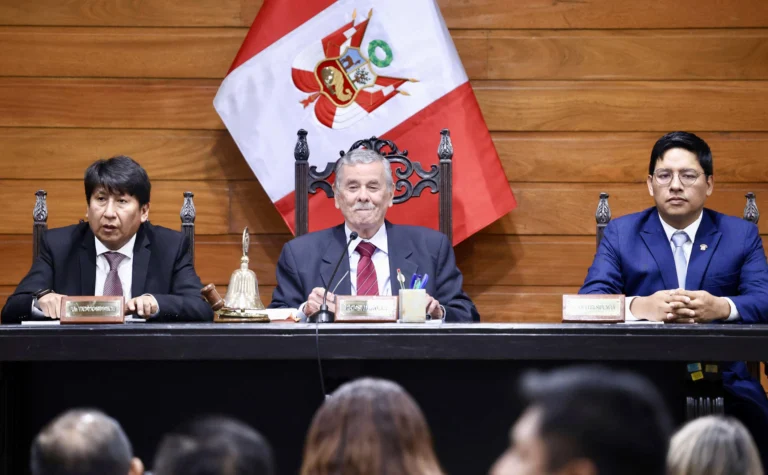
At 6 P.M. the parliamentary session will begin to elect the new President or Peru, the ninth in the last ten decades. Photo: EFE.
February 18, 2026 Hour: 4:20 pm
🔗 Comparte este artículo
The Peruvian Congress is scheduled to elect a new interim president, after Jeri’s removal. Four candidates, vie for the position amid significant national instability.
The Peruvian Congress is set to elect a new Iinterim President this Wednesday, February 18, after Jose Jeri’s removal, a rapid process that has deepened the South American nation’s ongoing political crisis.
RELATED: Peruvian Interim President Jose Jeri Dismissed by The Congress
After the deadline for registration of lists, the candidacies of the congressmen Segundo Hector Acuña Peralta, Maria del Carmen Alva Prieto, Edgard Cornelio Reymundo Mercado and Jose Maria Balcazar Zelada were registered to the presidency of Parliament.
The Parlamentarian Process
The extraordinary parliamentary session will commence this Wednesday at 06:00 P.M. local time, beginning with the reading of the four presented lists and the appointment of two scrutineers. Following this, congresspersons will be called in alphabetical order to cast their votes.
This snap election comes as the country navigates yet another period of significant political instability, highlighting the fragility of its democratic institutions and the constant challenges to governance.
According to established and legal procedure, a candidate must secure at least a simple majority (more votes in favour than against) among the deputies present in the session to be elected president by the Congress.
Should no candidate achieve the necessary votes in a first round, a second vote will take place between the two lists with the highest number of endorsements. The individual declared the winner will immediately be sworn in and assume their new office.
This swift succession mechanism aims to provide a temporary solution amidst the political vacuum, although critics argue it further destabilizes the political landscape by allowing rapid changes in leadership without broader consensus.
Four Candidates Vie
The four aspirants to the interim presidency represent diverse political backgrounds and include both experienced politicians and figures with controversial pasts, reflecting the complex political tapestry of Peru.
- Hector Acuña Peralta, a 68 years-old businessman, is completing his first parliamentary term. He began his career in 2021 under the conservative Aliance for the Progress Party (Alianza para el Progreso, in Spanish) but later switched to the Honor and Democracy bench. His brother, Cesar Acuña Peralta, is a presidential candidate for the upcoming April elections. Acuña’s trajectory highlights the dynamic and often fluid nature of political alliances within the Peruvian legislative body. His candidacy -applied with the approval of the spokesman Jorge Montoya Manrique- brings a business perspective, though his political experience is relatively recent, making him a newer face in the presidential race.
- Maria del Carmen Alva Prieto, a 58-year-old lawyer, previously presided over Congress in 2021. She is part of the right-wing Popular Action Party (Accion Popular, in Spanish), a party that has seen two previous presidents in Peru: Fernando Belaunde (1963-1968 and 1980-1985) and Valentin Paniagua (2000-2001). Alva’s career has been marked by multiple controversies stemming from her alleged racist language and aggressive behavior. She also verbally and physically assaulted native congresswoman Isabel Cortez, for which she later had to apologize. Her past actions raise questions about her suitability for a unifying leadership role, particularly in a country grappling with issues of social inclusion and native people rights. Her candidacy was formalized by the spokesman Edwin Martinez Talavera.
- Jose Maria Balcazar Zelada, an 83-year-old lawyer, is recognized both in Peru and internationally as a former member of the Supreme Court of Justice. He has been implicated in multiple cases of alleged corruption. His name also gained international notoriety following his controversial defense of sexual relations between older men and underage girls, despite such acts constituting a crime. His candidacy for the interim presidency has been endorsed by the Free Peru Party (Peru Libre, in Spanish). Balcazar’s contentious views and legal history present a highly divisive figure in the current political climate.
- Edgard Reymundo Mercado, a 73-year-old sociologist nominated by the center-left Democratic Popular Block (Bloque Democratico Popular, in Spanish), previously served as mayor of Chilca and began his career as a congressperson two decades ago. The politician was embroiled in a scandal in 2019 due to his alleged connection with Oscar Lopez Meneses, a former operative for Vladimiro Montesinos, as Reymundo’s name appeared on a list of calls made in 2012. Reymundo’s long political career and previous association with controversial figures underscore the intricate web of relationships within Peruvian politics. His candidacy, driven by the center-left, was presented by Ruth Luque.
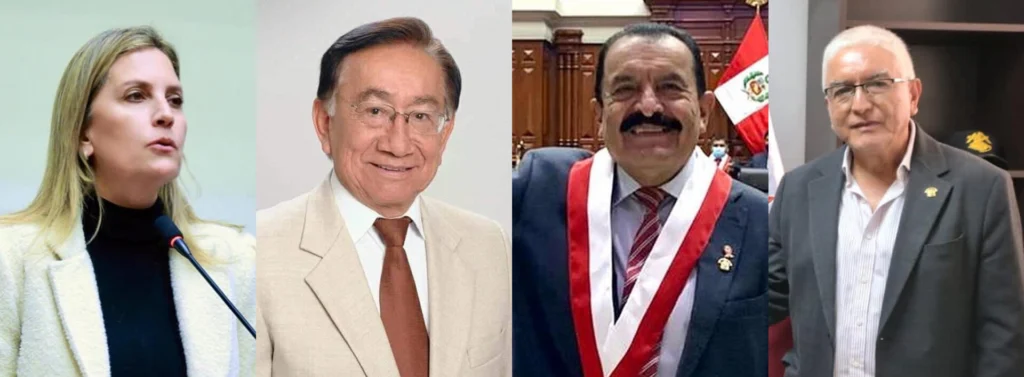
The Peruvian Congress faces a challenging decision as it seeks to stabilize the nation’s leadership under intense scrutiny and amidst significant public discontent.
The candidate that results winner of the parliamentary elections will become the new (interim) President of the Republic until April 12, when the popular presidential eleccions will be held.
Author: Laura V. Mor
Source: Agencies